Memory Without Curation:
Learning Multi-Stream Latent Memory for Robot Policies

Yilin Wu1,2,† Rutav Shah1,3 Shuaiyi Huang1 Sumedh A. Sontakke1 Homanga Bharadhwaj1,4 Andrea Bajcsy2 Max Simchowitz1,2 Guanya Shi1,2
1Amazon FAR 2Carnegie Mellon University 3The University of Texas at Austin 4Johns Hopkins University †Work done during the internship at Amazon FAR

Approach

Method

Trace how visual, action, and state histories become compact latent memory. Interact with each component to inspect its exact RMBench ablation.

Visual, action, and state history from timestep 0 through t is compressed into latent memory.

t = 00:34 / 01:08
Encoded: 0 → t Future: t → T

Interactive IMPRINT method

Input
Dust Table example

Multi-stream history

Bottleneck size B
Policy-agnostic

Memory encoder

Latent history encoded from 0 → t (50%) Schematic token view · B = 256
Learn
Memory objectives

Teach memory what to retain

Memory decoder Sample and reconstruct the episode

RMBench ablation

Exact appendix row

All objectives (IMPRINT)

72.7% Best reported configuration

Per-task success from the matching appendix row.

View the paper method figure
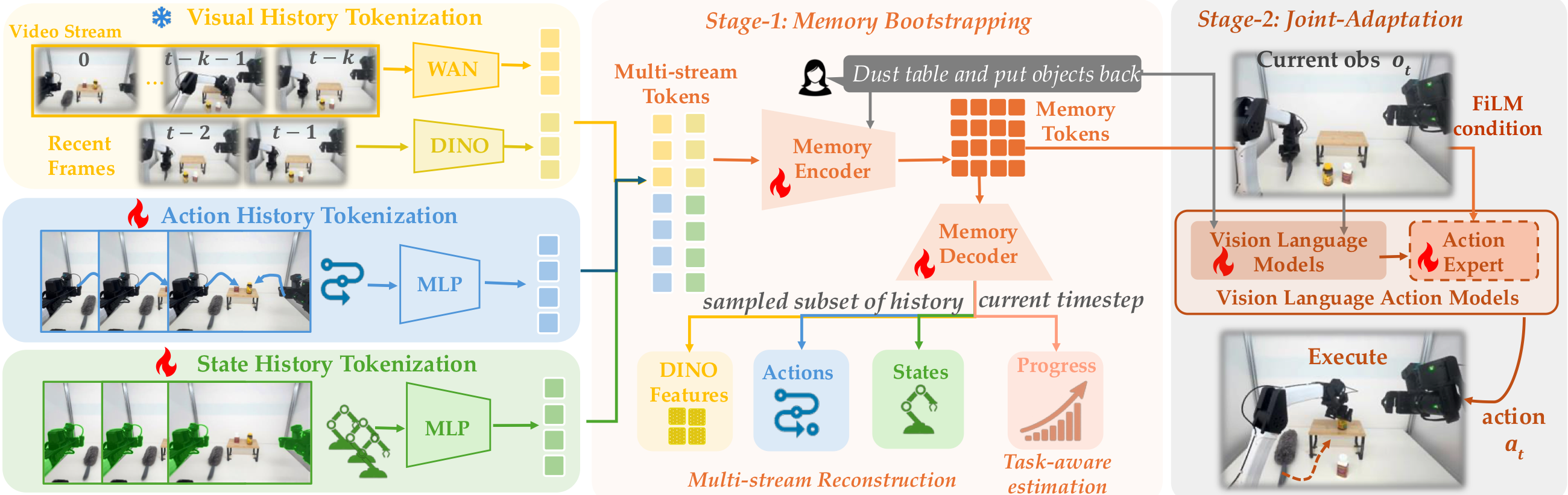
Overview of multi-stream history tokenization, memory learning, and joint adaptation with a vision-language-action model
Visual history is tokenized alongside executed actions and proprioceptive states. A memory encoder compresses these streams into latent tokens; Stage 1 reconstructs sampled history and estimates task progress, while Stage 2 jointly adapts the memory and VLA for action generation.

Interactive Example

Choose an in-context folding example

Compare all four demonstrated styles across four towel colors. Each cell shows only the external-camera stream; select one color × style combination to compare its IMPRINT execution with a matched OOD execution. Successes and failures are labeled explicitly.

Orange
Orange towel, Style 1
Orange towel, Style 2
Orange towel, Style 3
Orange towel, Style 4
Dark blue
Dark-blue towel, Style 1
Dark-blue towel, Style 2
Dark-blue towel, Style 3
Dark-blue towel, Style 4
Blue
Blue towel, Style 1
Blue towel, Style 2
Blue towel, Style 3
Blue towel, Style 4
Pink
Pink towel, Style 1
Pink towel, Style 2
Pink towel, Style 3
Pink towel, Style 4

Selected demonstration

Orange towel · Style 1 executions

The selected IMPRINT and matched OOD executions use the same demonstration; badges mark each outcome.

Interactive attention trace

How memory attends over time

Compare one Cover Blocks episode across E2E, Frozen, and Ours.

Selected recipe
Ours 100%
Joint memory-policy adaptation · task success
Cover Blocks memory attention
0% through episode
Policy input Current observations
Action step 0
Current observation Head camera
Current observation Left wrist camera
Current observation Right wrist camera
Memory read Highest-attention history
One retrieved moment per stream · bars normalized within this step
Head camera
w = 0.3712
History step 0
Left wrist
w = 0.1880
History step 0
Right wrist
w = 0.1015
History step 0
Action history
w = 0.1708
History step 0
State history
w = 0.1685
History step 0
Temporal trace Attention over episode history
Brighter color means greater attention
Attention over head-camera, wrist-camera, action-history, and robot-state streams
Episode step 0 Episode step 0
Encoder attention Memory queries read from Share of cross-attention assigned to each input token stream
Encoder output 256 latent memory tokens
Historical video0.0% Compressed completed chunks
Recent images66.1% DINOv3 tokens from recent frames
Executed actions17.1% Action tokens through the current step
Proprioceptive states16.8% Robot-state tokens through the current step
Ours · frame 1 of 20 Current input · recalled history · stream attention
Episode start Frame 1 / 20 Episode end

Each retrieved card shows the top-attended item for its stream; w is its attention weight, and the outline locates it in the temporal map.

Experiments

Result Highlights

Success versus inference latency highlight showing EventVLA as 7.8 times slower
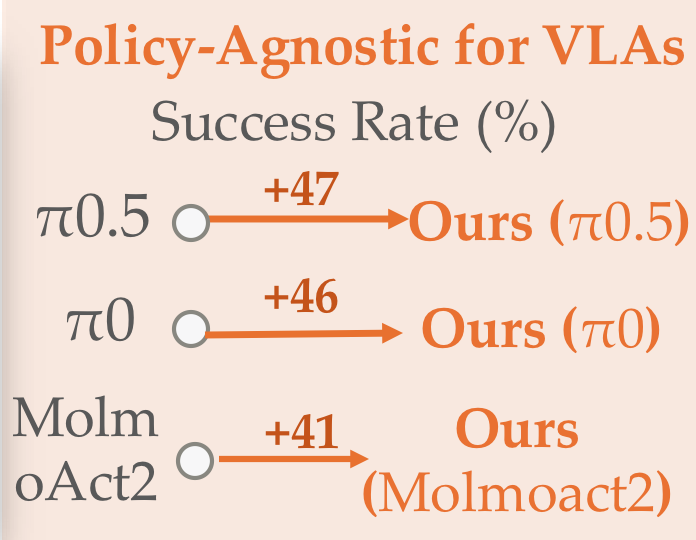
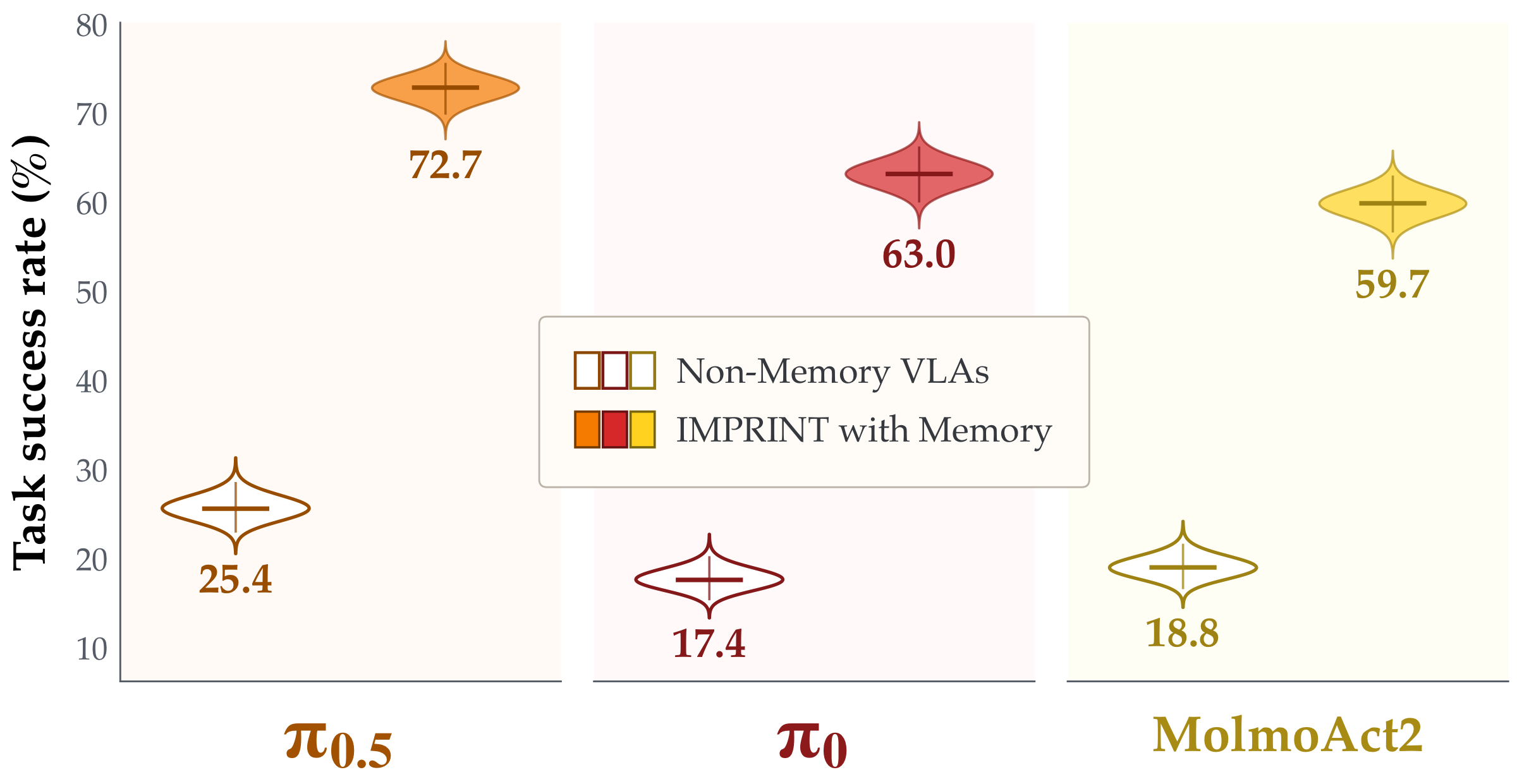
Success improvements across three VLA backbones
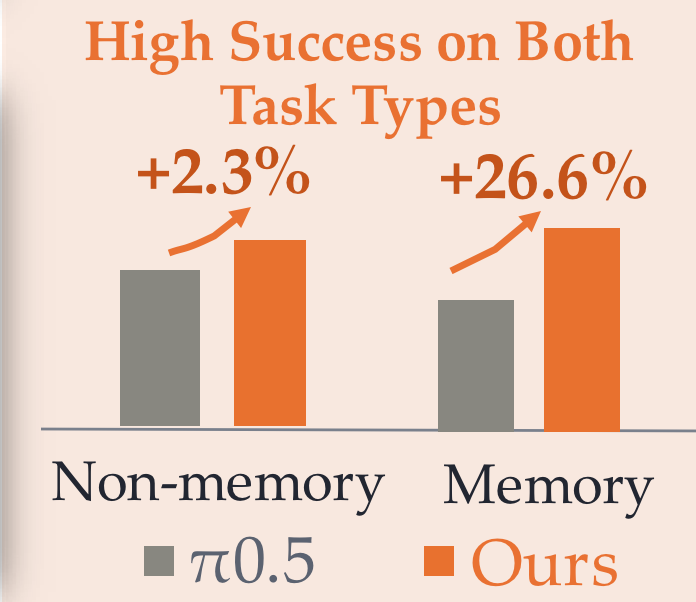
Success improvements on non-memory and memory task groups

Contributions

  1. We propose IMPRINT, a policy-agnostic latent memory framework that efficiently compresses multi-stream histories and trains with history reconstruction and progress estimation before joint fine-tuning with the policy.

  2. We systematically analyze how memory capacity, encoding, training objectives, and training recipes affect downstream performance.

  3. Across RMBench, a 12-task RoboCasa benchmark, and three real-world tasks, IMPRINT improves success over the base VLA by 47.4% on RMBench and 50% in the real world, while achieving the lowest average latency and highest success among the memory baselines in the latency comparison.

Evaluation

Real-World Evaluation

Select a task, compare the reported result, and browse every associated rollout. Green and red labels indicate success and failure under the paper's evaluation criteria.

Task prompt

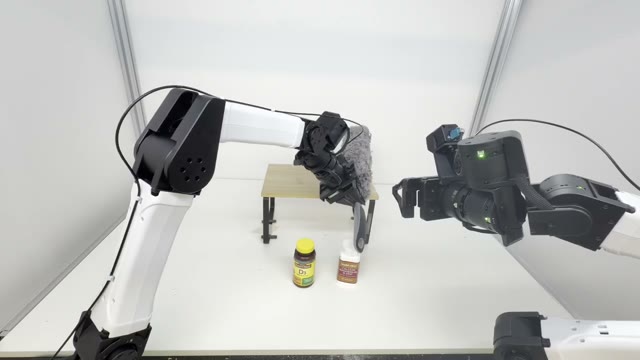
The robot must place the objects down upright, dust the table exactly once, and return the objects upright to the small table in the correct left/right arrangement.

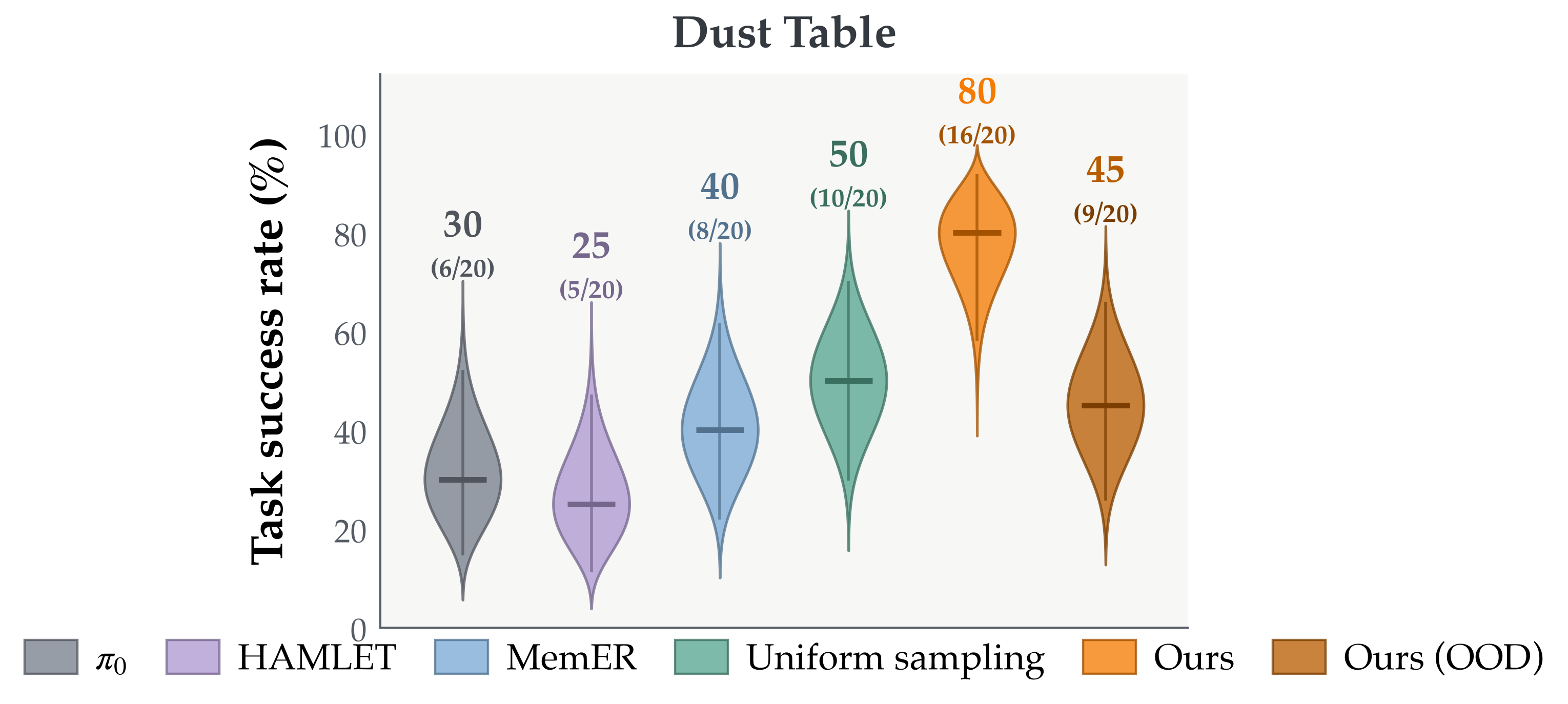
Dust Table success-rate distributions across real-world methods

Reported task result

Dust Table

Result analysis IMPRINT reaches 80%, 30 points above uniform sampling; the unseen-object setting reaches 45%.

Method

IMPRINT

16 / 20 successful

Success

Dust Table

Trial 01

IMPRINT · Success

Associated trials

Select a rollout

01 / 20

Success Failure

Evaluation

RMBench Simulation Results

Per-task and average success on the nine memory-dependent tasks in RMBench.

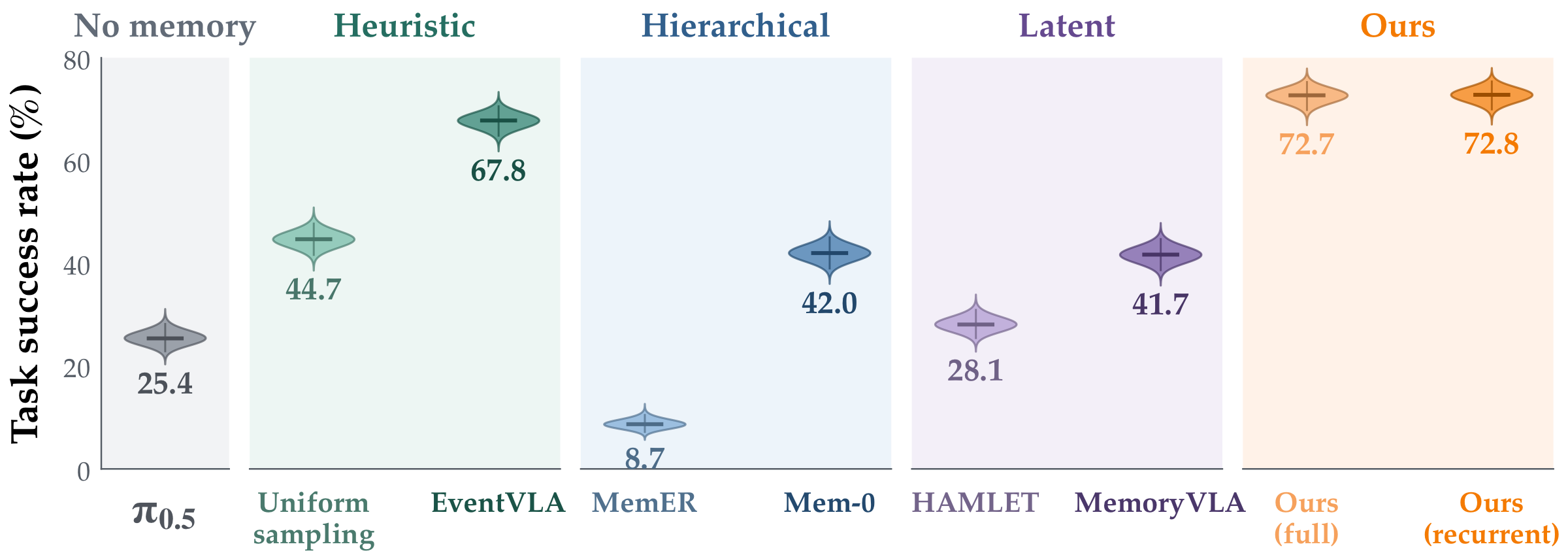
RMBench task success distributions for no-memory, heuristic, hierarchical, latent, and proposed memory methods
Full-attention and recurrent IMPRINT reach 72.7% and 72.8% average success, respectively.

Result analysis Recurrent IMPRINT leads the strongest baseline by 5.0 points and reaches 99–100% on five tasks; remaining errors cluster in Observe / Pick, Battery, and Press Button.

Evaluation rollouts

Representative RMBench trials

Choose a task and drag the method bar to compare logged evaluations.

Method Ours (recurrent) 6%
Task prompt

Pick the object matching a target shown before occlusion.

Success
Representative successful rollout
Failure
Representative failed rollout

One valid logged camera mosaic is shown for each available outcome. Aggregate rates are computed from all 100 evaluation trials.

Evaluation

RoboCasa: Memory and Non-Memory Tasks

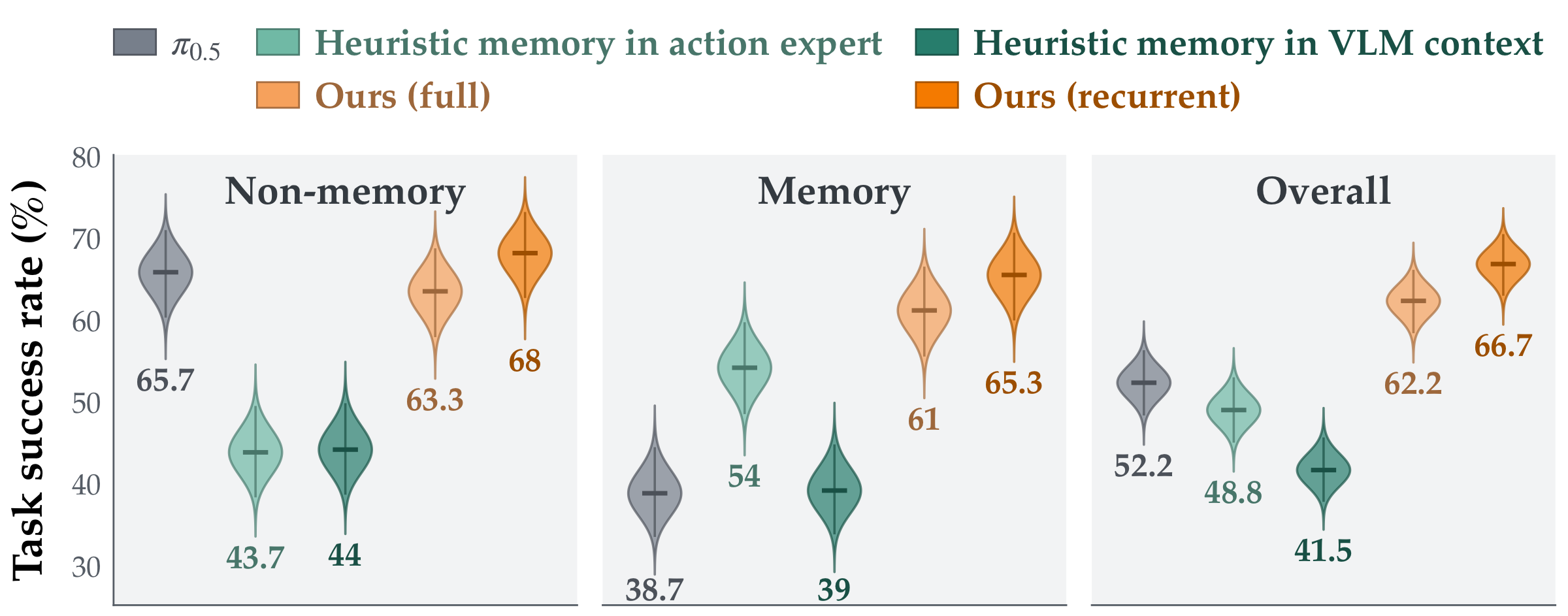
Average success on memory-dependent and memory-free task groups in RoboCasa.

RoboCasa success distributions for non-memory, memory, and overall task groups
Recurrent IMPRINT reaches 65.3% on memory tasks and 68.0% on non-memory tasks, for 66.7% overall.

Result analysis Heuristic history helps memory tasks but hurts non-memory tasks. Recurrent IMPRINT improves both, suggesting its latent memory is used only when needed.

Full evaluation archive

Browse RoboCasa rollouts

12 tasks · 5 methods · 50 rollouts · 3 synchronized camera views

Method Ours (recurrent) Archive: 45 / 50 successes
Task prompt

Place the {fruit} in the sink; recall which side of the sink it was observed on.

Memory task

Retrieve Fruit · Rollout 01

Mem Fruit In Sink Left Far · episode 000

Success
Loading rollout…
Success
Left agent view
Loading rollout…
Success
Right agent view
Loading rollout…
Success
Wrist view

Associated rollouts

Select a trial

01 / 50

Success Failure

The three views are synchronized and show the same rollout. Success and failure labels follow the supplied archive manifest.

Evaluation

Success vs. Inference Efficiency

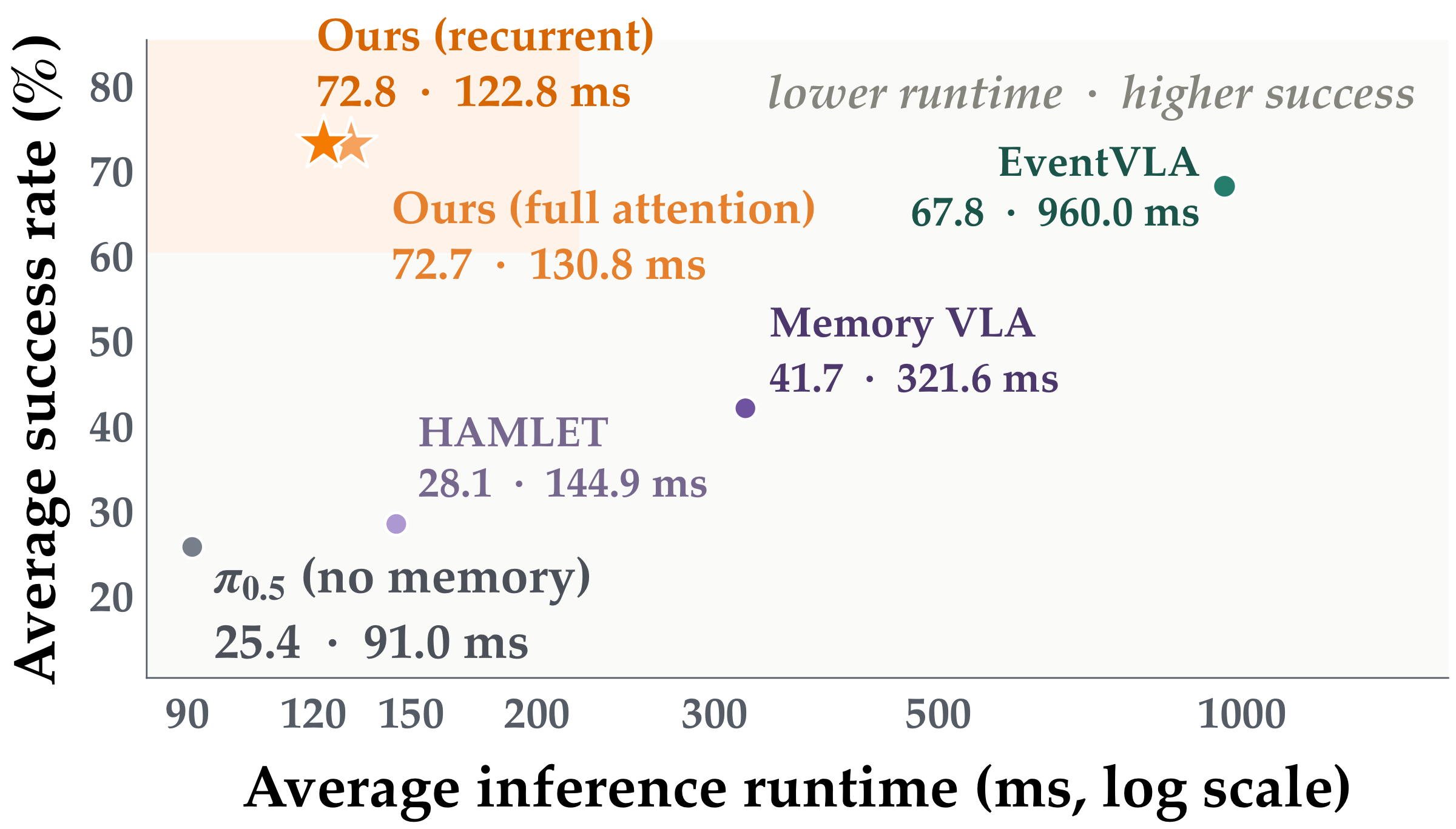
Average RMBench success versus inference latency per action chunk.

Inference runtime versus average RMBench success rate
Recurrent IMPRINT reaches 72.8% success at 122.8 ms per action chunk.

Result analysis Recurrent IMPRINT achieves the best success–latency tradeoff: 72.8% success at 122.8 ms, only 31.8 ms slower than the no-memory policy and faster than full attention.

Ablations & analysis

Memory Encoding

Memory bottleneck capacity and full-attention versus recurrent encoding.

Memory Capacity

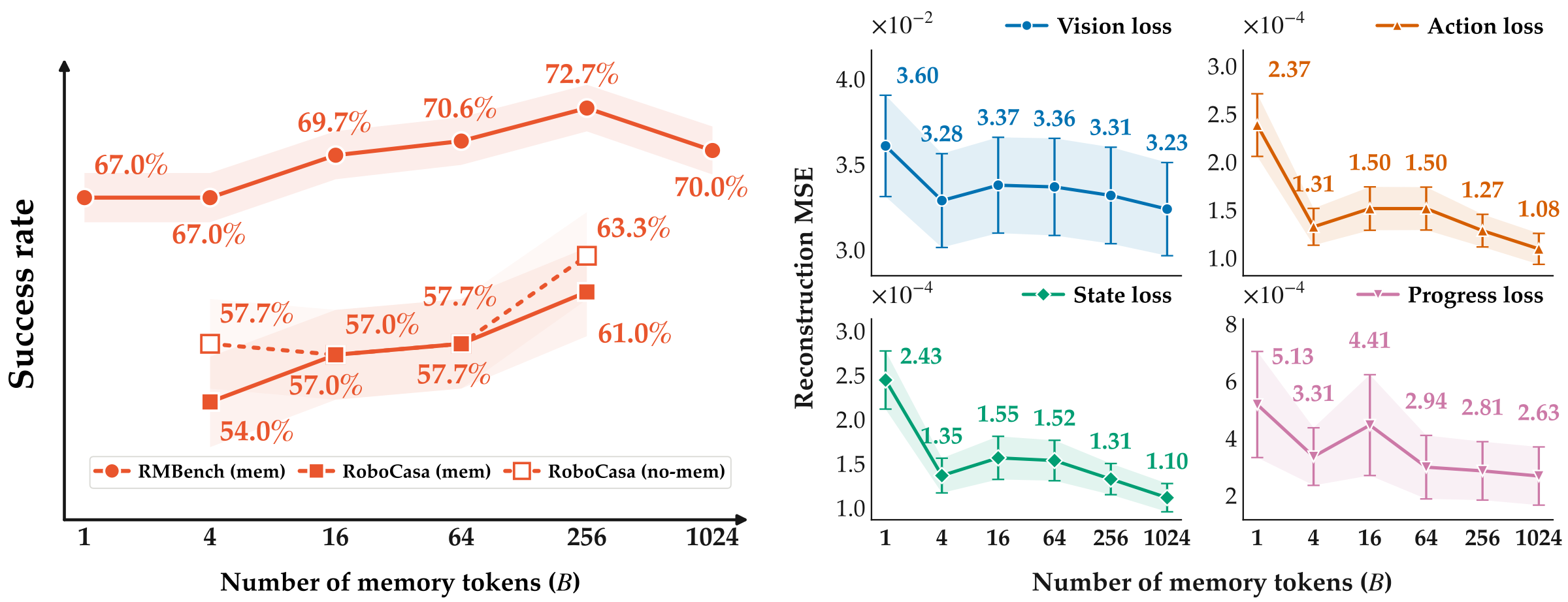
Success rate as the latent-memory bottleneck scales from 1 to 1024 tokens
Performance and Stage-1 supervision loss as the bottleneck scales from 1 to 1024 latent tokens.

Result analysis Success rises from 67.0% with one token to 72.7% with 256. At 1024 tokens, reconstruction loss improves but success falls to 70.0%, so lower loss does not guarantee better control.

Full Attention vs. Recurrent Encoding

Beta-posterior success distributions for full-attention and recurrent memory encoding on RMBench and RoboCasa
Recurrent encoding matches full attention on RMBench and improves the RoboCasa overall average.

Result analysis Recurrent and full attention tie on RMBench. Recurrence raises RoboCasa success from 62.2% to 66.7% while reducing latency from 130.8 to 122.8 ms.

Ablations & analysis

Memory Attention Analysis

Cover Blocks analysis using the unsupervised 50–100% history projection and stream attention at step 750.

Paper figure comparing E2E, frozen, and adapted memory through t-SNE embeddings, linear-probe and task success, attention over history streams at step 750, and Cover Blocks outcomes
The paper figure compares representation structure, linear-probe and task success, attention over five history streams at step 750, and the resulting Cover Blocks action for E2E, Frozen, and Ours.

Result analysis Across end-to-end, frozen, and jointly adapted memory, probe accuracy rises 19.9% → 83.3% → 91.5% and task success 15% → 35% → 100%, linking structured memory to better control.

Ablations & analysis

Memory Learning and VLA Flexibility

Training-recipe ablations and results across three VLA backbones.

Training Recipes

Posterior violin comparison of end-to-end training, frozen bootstrapped memory, and jointly adapted memory
Multi-stream memory supervision improves over end-to-end action supervision, and joint adaptation improves performance further.

Result analysis Supervising memory to retain multiple streams and estimate progress raises average success from 50.8% to 58.8%; joint memory–policy adaptation reaches 72.7%.

VLA Flexibility

Posterior violin comparison of success with and without memory for pi zero point five, pi zero, and MolmoAct2
The same memory pipeline improves average success for π0.5, π0, and MolmoAct2.

Result analysis Memory improves average success by 47.3, 45.6, and 40.9 points for π0.5, π0, and MolmoAct2, respectively, showing the approach transfers across VLA backbones.

Memory supervision ablations

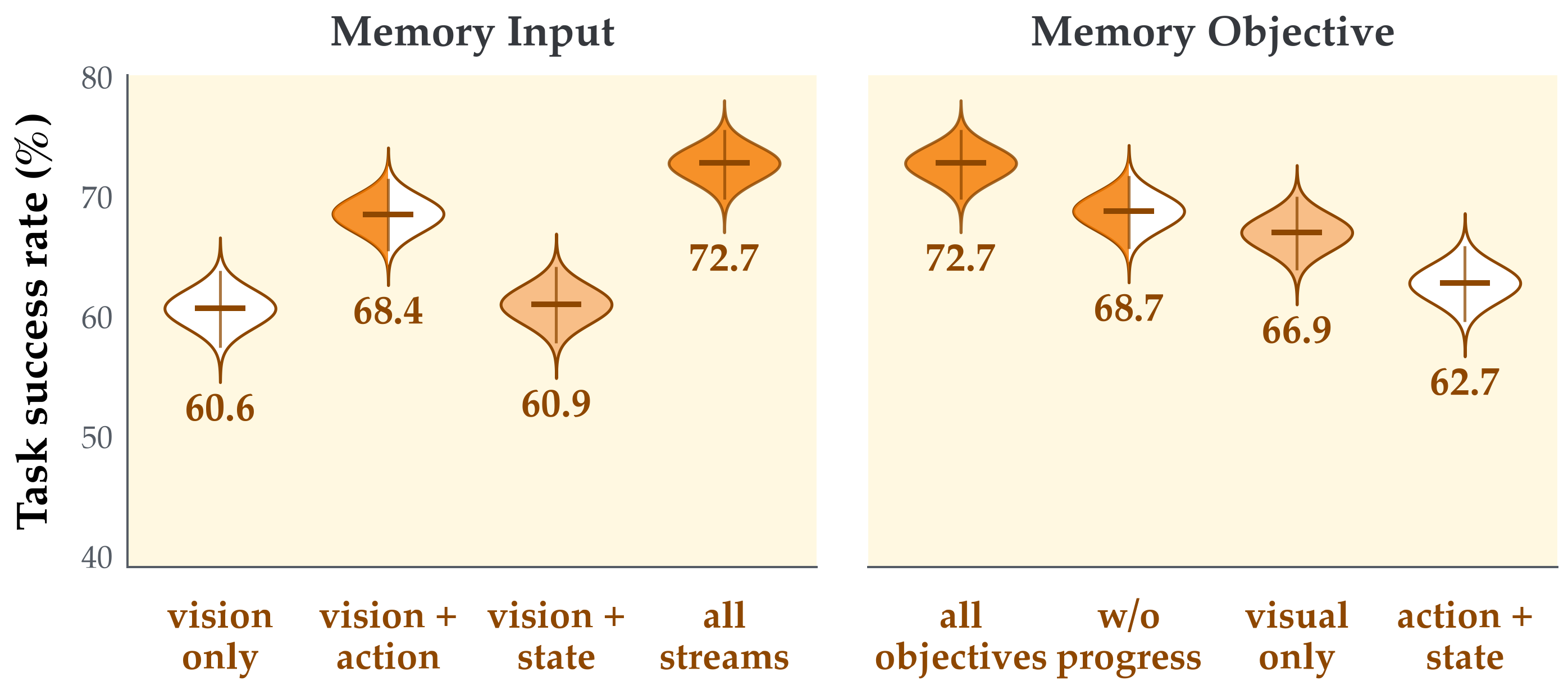
Which inputs and objectives make memory useful?

Full-attention encoder with a fixed 256-token memory bottleneck.

Side-by-side posterior violin plots comparing historical memory inputs and memory bootstrap objectives
The left panel ablates which history streams enter memory; the right panel ablates which reconstruction and progress objectives supervise memory.

Result analysis Visual-only memory loses 12.1 points, and visual-only reconstruction loses 5.8 points. Combining visual, action, and state histories with reconstruction and progress supervision performs best at 72.7%.